Trending Topic

Dragon Ball Series Order: The Easy, No Nonsense Watch Guide

Read Time:15 Minute, 12 Second

Article Summary

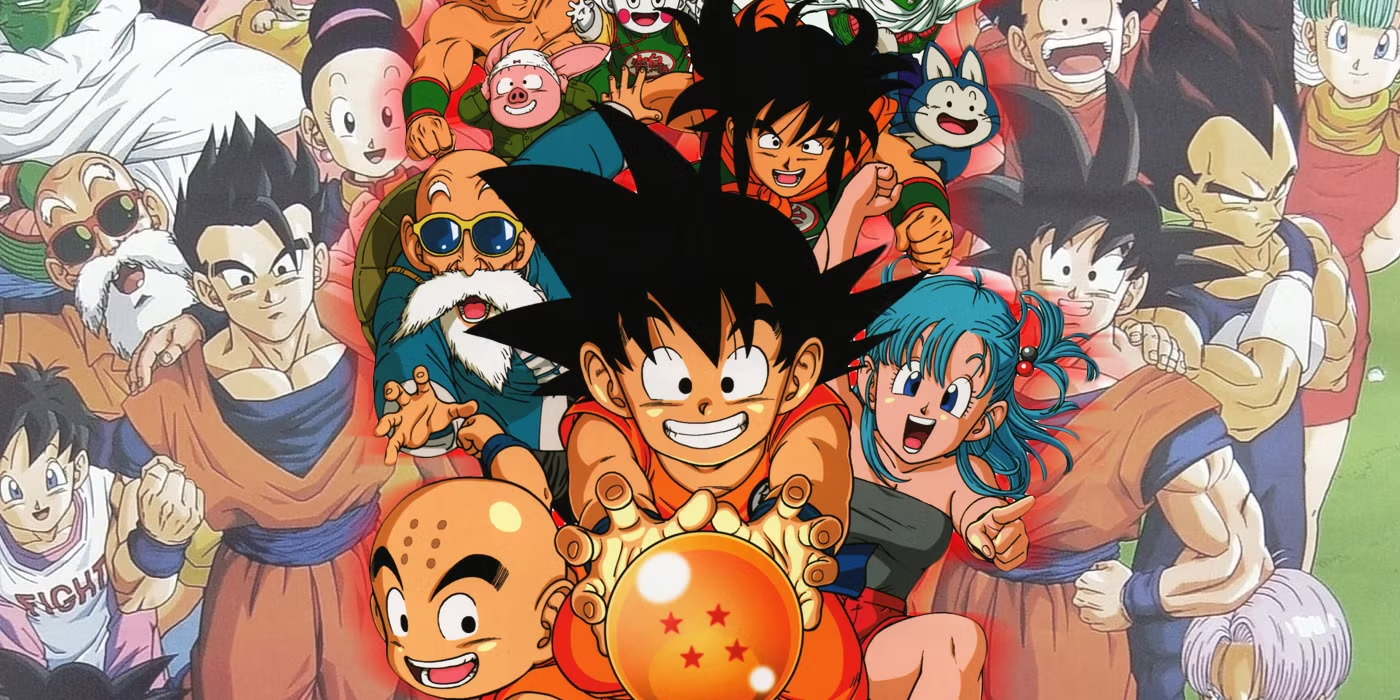
Dragon Ball is easily the most recognizable anime/ manga series of all time. The transformations, the art style, the iconography, all of it just screams timeless and easy to pick out. This series has been going strong since 1984, and any anime fan knows there are tons of different Dragon Ball series. Even for a modern fan, these can be very confusing. This Dragon Ball series order guide is meant for both new and returning fans who have never quite wrapped their heads around the deep, sometimes confusing amount of shows and movies in this franchise. So, let’s get into the different anime installments, as well as what is and isn’t canon, starting with the original Dragon Ball.  

Dragon Ball (1986-1989)

This is the very start of the series. Goku, the main monkey boy, is a kid. The show has a lot of comedy, with bits of martial arts sprinkled in. This portion of the anime is incredibly beloved by many long-time fans for how unique it feels compared to the rest of the series, largely because of its lower stakes. The first couple of arcs are more adventure-themed. Goku and his friends are out looking for the Dragon Balls, seven mystical artifacts that, when collected, will grant one wish. Eventually, bad guys get their hands on the Dragon Balls, like the Red Ribbon Army, and chaos ensues. But as the series progresses, particularly at the King Piccolo arc, fighting gets to be a bigger and bigger element of the show. By the end of the original show, Goku and his rival, Piccolo Junior, are flying around an arena, exchanging blows and even energy blasts. Once you finish the original anime, and you still want a bit of that classic Dragon Ball fun, you can watch its follow-up movies.

Dragon Ball Movies

“Curse of the Blood Rubies (1986),” “Sleeping Princess in Devil’s Castle (1987),” and “Mystical Adventure (1988),” the original Dragon Ball movies, are a combination of original events, as well as retellings of the series arcs. They are non-canon, but special because there are only three of them, and they have that classic, original Dragon Ball charm. There’s also the 10th-anniversary retelling of the series, The Path to Power (1996). Once you are finished watching those, that takes us right to Dragon Ball Z.

Dragon Ball Z (1989-1996)

DBZ needs no introduction. This is the 90s anime juggernaut. Goku is an adult with a kid of his own, new allies, new enemies, and new hairstyles, too. The amount of content in this single part of the franchise is astounding.

Dragon Ball Z is a bit confusing due to the different anime series under its umbrella. The original Dragon Ball Z anime from the 1990s has close to 300 episodes, with dozens of portions of “filler”, or non-canon episodes, that the anime producers put in for the sake of killing time. Many hardcore fans love the filler due to how sometimes goofy or charming it can be. The filler episode where Goku and archnemesis turned friend Piccolo get their driving licenses is nothing short of iconic. This filler episode is an incredibly inconsequential episode, but it has been referenced many times in games like Dragon Ball FighterZ and Dragon Ball Z: Kakarot. However, asking a modern anime fan to watch 300 episodes nowadays is a little much. That’s where Dragon Ball Z Kai (2009-2015) comes in. Kai is an anime series that tells the original story of Z; it just cuts out the filler. It also has new voice acting and re-animated scenes. For many fans, Kai is the definitive way to watch Z, but for more nostalgic ones, they still prefer the original. For newcomers, Kai is the best choice. The pacing is leagues better; it’s not even a comparison. The story is still just like the original, though. DBZ is known for its fighting-centric arcs, its power-based transformations, and its iconic final battles. Every arc here has something for any fan of action or shonen anime. The Saiyan Arc starts with a twist that changes Goku forever, and adds even more powerful, intimidating characters like Raditz, Nappa, and the fan-favorite Vegeta.

The Frieza arc builds directly off of this one and introduces one of the most iconic antagonists ever, the titular space emperor. It also has Goku going Super Saiyan, which is no contest, the most recognizable transformation in anime, ever. Other characters like Goku’s best friend Krillin and Goku’s rival, Piccolo, get to shine here, too. After the battle against Frieza, arguably the best story starts. The Cell arc has even more Super Saiyans, world-ending threats, and heart-pumping action than one can believe. Once this saga ends, and after a time jump of seven years of peace, the Majin Buu arc begins. 

This is certainly the weakest arc, but still full of incredible fights, insanely popular new transformations, and even fusions of characters! These new transformations and characters led to many other new characters in some of the non-canon movies. Speaking of non-canon, DBZ, in all its popularity, has tons of supplementary material. This is where it gets a little dicey. Some of the animated specials are canon to the story, but most of the movies that came out as the original anime aired are not canon. The “TV-Special Movies”, such as the ones with Bardock and Trunks, are completely canon to the story. 

Dragon Ball Z Movies

“Bardock- The Father of Goku” is a short film about Bardock, Goku’s Saiyan father, and his failed rebellion against Freiza. “The History of Trunks” is another short film about Future Trunks, the son of Vegeta, and a dark, alternate future where the androids take over Earth. In this timeline, Goku and the rest of his friends are dead, which pushes Trunks to go to the past to prevent this from happening. These movies aren’t required viewing, but add to thestory. 

The rest of the DBZ movies, however, are not canon. They were released alongside the anime and should be watched intermittently during every arc. You can group the different movies into the various arcs of Dragon Ball Z. For example, once you get close to completing the Saiyan Arc, you can watch “Dead Zone,” “The World’s Strongest,” “The Tree of Might,” and “Lord Slug.” A lot of these first DBZ movies are fun because they focus heavily on the martial arts fighting that the series started with. 

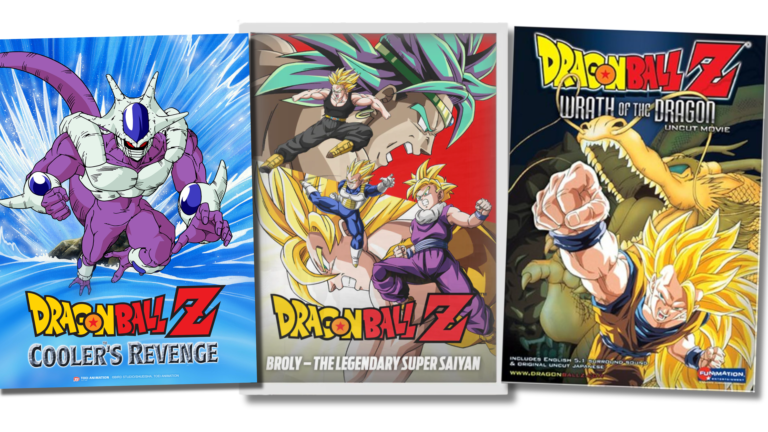
Once you finish the Frieza arc, give “Cooler’s Revenge,” “The Return of Cooler,” and “Super Android 13” a watch. Cooler is Frieza’s brother, and has a great design and really cool powers. He comes back as an android, and after that, the Z-fighters fight real androids! Once you get deep into the Cell arc, you have to watch “Broly: the Legendary Super Saiyan.” For a non-canon character, Broly has got to be the most iconic in the series. His dynamic with the rest of the characters, notably Goku, is interesting and fun too. He has a stellar character design and is wonderfully acted in both the Japanese and English dubs. After you finish the Cell saga, give “Bojack Unbound” a try. Bojack is a space pirate with a gang of brutal fighters that Gohan has to defeat. After the Majin Buu arc starts, I would watch “Broly- Second Coming” and then “Bio Broly.” Both these movies aren’t as beloved as the first Broly film, but they’re still a fun excuse to see more of the character once he returns. Don’t think too hard about how Broly returns in both movies, though, since they are pretty nonsensical. 

Once you finish the Majin Buu arc, I would watch “Fusion Reborn”, which gave way to Gogeta, one of the most popular characters in the entire series. It makes sense, since it’s a combination of Goku and Vegeta. Janemba is also a cool, evil character with an incredibly sick character design. The last Z-era movie to watch is “Wrath of the Dragon,” a fun, almost epilogue to DBZ. This movie has some incredible animation and shows off great character development for fighters like Vegeta. 

Those are all of the Z-era movies that were made in the late 80s to mid 90s. There’s also “The Return of Son Goku and Friends,” a 2008 special that introduces Vegeta’s brother, Tarble. This story is almost like a slice-of-life tale for the characters. It’s a very low-stakes story; it was really just an excuse for the animation studio to make more Dragon Ball Z content, since it came out years after the original anime ended. While this special came out of nowhere, it is considered canon, as Tarble is briefly mentioned in other canon projects like Dragon Ball Super: Broly.

The DBZ movies have a ton of really fun and iconic characters, so they’re still recommended. They have stellar animation, great fight scenes, awesome music, and some of the most iconic characters in the series, like the previously mentioned Legendary Super Saiyan,  Broly, or Frieza’s Galaxy-conquering brother Cooler. Another series that is not canon, but still beloved by some fans, is Dragon Ball GT. 
set of japanese animation movies
Dragon Ball Z movies

Dragon Ball GT (1996-1997)

This was an official anime released after DBZ in the late 1990s. This anime has some very iconic characters that many fans love, but it is not recognized as canon. 

Akira Toriyama, the creator, had extremely minimal input on the series. He gave Toei Animation, the studio directing the anime, design concepts for transformations, like Super Saiyan 4. Toei wanted to ride the hype of the original DBZ anime ending, and they felt a new, original TV anime would do great. Toriyama gave bare ideas for where the story could go and the title of “GT”. He did not write any scripts or specific plot details. This is why many fans consider it to be non-canon, unlike another TV anime series that we will talk about soon, which had Toriyama’s direct involvement. 

That being said, Dragon Ball GT is still a fun, harmless show. The first arc is a direct callback to the original show. In it, Goku, Trunks, and Pan, Goku’s granddaughter, must travel the galaxy looking for the Black Star Dragon Balls, to wish for Goku to go back to his original form. Yes, the main gimmick of GT is that Goku was transformed back into a kid. Another notable arc is the Baby arc, which has arguably the most iconic GT villain, Baby. He is a member of the Tuffles, a race that was wiped out by the Saiyans. He comes to Earth and essentially tries to take over the whole place. This is also the arc where Goku first goes Super Saiyan 4, which might just be the number one fan-favorite transformation. 

The Super 17 arc is a very short-lived story; it’s only a couple of episodes at that. Two versions of Android 17, a character from Z, combine into one super-powerful character that Goku must defeat. After that, the final arc has another iconic villain, Syn Shenron. He has a great design and a cool voice. Not as cool as the strongest character in GT history, though, Super Saiyan 4 Gogeta. Yes, this, for many years, was the most powerful character we had ever seen in the Dragon Ball series. The powerscaling at this point in the anime just gets out of control, even more than it already is. This last arc goes on for a bit too long, but the best part is the ending. Dragon Ball GT has a definitive ending to the Dragon Ball series that hits the emotional heartstrings. It does wrap up the Dragon Ball story quite well.

Pre-Dragon Ball Super

After GT, there was a drought of Dragon Ball content until Dragon Ball Z: Battle of Gods in 2013. In this film, Beerus, an incredibly powerful God, is introduced, and this opens up a brand new level of power for Goku, which is Super Saiyan God. This Z movie is canon, as well as Dragon Ball Z: Resurrection F, a movie that has the return of Freiza, and a new transformation, Super Saiyan Blue. These movies were eventually adapted into a new TV anime, Dragon Ball Super. This is an incredibly important and canonical addition to the series. 

Dragon Ball Super (2015-2018)

Dragon Ball Super chronicles the story of Goku and his friends as they continue to grow even stronger and fight even greater threats. 

After the first two movies were adapted, the first Super-original arc was a universal tournament. Characters like Hit, an assassin, and Cabba, a Saiyan from another universe, were introduced, who became beloved by fans. Then, Future Trunks came back for the Goku Black arc. In this story, Zamasu, a god from another timeline, took over Goku’s body, and through time-traveling shenanigans, is trying to destroy every mortal in the universe. This arc has Super Saiyan Rose, a pink form that many fans took a liking to. After this, the final arc took place, which was a multi-universe Tournament of Power. This arc is the longest in Super’s history, and it showed iconic characters, such as Jiren, the strongest fighter Goku has ever fought! Super went on for a couple of years, until it eventually wrapped up in 2018. In 2019, Dragon Ball Super: Broly, another movie, was released. 

Dragon Ball Super Movies and Content

This movie made a once non-canon character, Broly, officially canon. Goku and Vegeta run into Broly and discover how seemingly endless his power is. This movie canonized not only Broly, but also Gogeta! The 2022 movie Dragon Ball Super: Super Hero was also canon. This movie was more centered on characters like Gohan and Piccolo. They both got insane new transformations that put their power on the same level as Goku and Vegeta. Notably, Gohan got his new “Beast” transformation, which has quickly become a popular transformation in the pantheon of this series.

In the modern age of Dragon Ball, most projects, whether they are movies or shows, are considered canon. There is still some fun non-canon stuff that is incredibly popular with the worldwide Dragon Ball audience. Super Dragon Ball Heroes is a card game that also has an anime along with it. The game and anime are both beloved due to how insane the series is. There are alternate-universe characters like Golden Cooler, Super Saiyan 4 Broly, and Capsule Corp Goku. These versions of these beloved characters are interdimensional and make Super Dragon Ball Heroes feel like a fun, non-canon side story. With all of Super being done, this leads us, finally, into Dragon Ball Daima. 

Dragon Ball Daima (2024)

A recently released TV anime that harkens back to the adventure vibe of the original Dragon Ball, this series is the most recent at the time of writing this article, only coming out in 2024. This show was pretty short-lived, only airing for one anime season, but it was enjoyed by fans. 

In this show, Goku and all his friends are transformed into kids by a mysterious force, and they travel to a new realm to get to the bottom of it. This series also has its own Super Saiyan 4 transformation that is similar, yet unique enough from the one found in GT. Since it is the newest series to air, it has been adapted into many Dragon Ball video games and multimedia series like Dragon Ball FighterZ, Dragon Ball Xenoverse 2, and Dragon Ball Z: Kakarot.

What’s Next?

The future of the series looks incredibly bright. Dragon Ball Super: Beerus has been announced. 

This is a remastered TV anime with redrawn animations for the original arc from Super. The clips and screenshots shown off so far look nothing short of incredible. There have also been other announcements for the series. The fan-favorite “Moro” arc from the Dragon Ball Super manga will be getting an animated adaptation. This arc is widely beloved for the super cool new forms, like Ultra Ego Vegeta, True Ultra Instinct, as well as the titular new villain, Moro. Fans love the Moro arc due to how it was the first original Super arc in the manga, once the anime wrapped up. 

This arc has so many climactic fights with Goku, Vegeta, and Moro, as well as new and exciting plot development with characters like Bardock and Black Frieza. The implications for this arc and the greater scope of Dragon Ball are massive, so the news of it getting animated is huge, considering how many fans love the arc and how long they have been clamoring for an adaptation. 

With so many entries spanning decades, Dragon Ball can feel overwhelming, but it doesn’t have to be. Ultimately, the watch order and how much of the series you take on is entirely up to you. Check out the original series and Z, dip into the non-canon movies for a good time, and work your way toward the modern era with Super and Daima. The recent films alone are reason enough to get excited about where the franchise is heading. However you choose to watch, there’s never been a better time to be a fan.

📬Sign up to PopPulse Digest, our free weekly newsletter, and join the community here to stay plugged into pop culture across gaming, anime, and comic book TV & movies, notable deals, plus more.


ABOUT AUTHOR

Leave a Reply

Your email address will not be published. Required fields are marked *

group of 4 warriors with swords and staff Previous post Final Fantasy x Magic: The Gathering (Now What Happens?)